

The Cheapest Privacy Fence Costs the Most: What Fencing Really Costs Over 20 Years
Every privacy fence cost guide online stops at the same number: the install invoice. That’s the wrong number. A fence sits outside, in the weather, for twenty years or more. What it costs isn’t what you pay to put it up — it’s what you pay to keep it standing and looking decent over its entire life. Most cheap fences are only cheap on day one. Here’s the honest math, with real 2026 numbers, on what privacy fencing actually costs.
Day one: what each option costs installed
Standard 6-foot privacy fence, installed, per linear foot. These are current ranges — they move with location, installer, and job size.
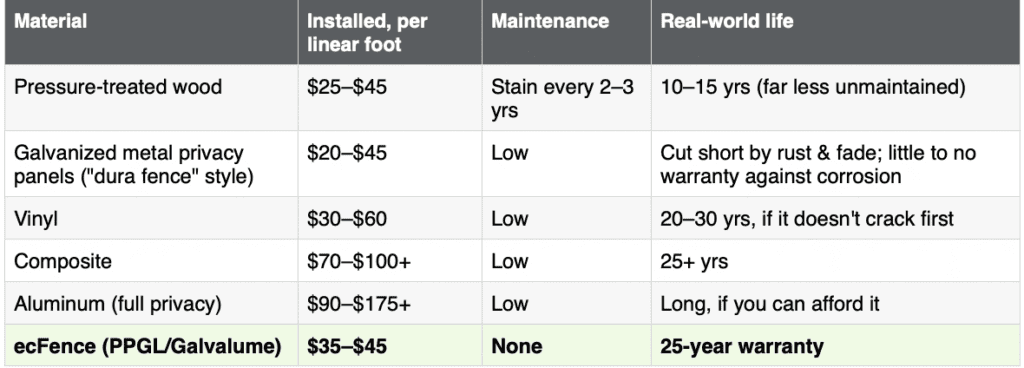
ecFence is not the cheapest fence on this list. The cheapest pressure-treated wood and the cheapest galvanized metal panels beat it on the install invoice. If the only horizon is day one, those win.
Also worth noting: aluminum. Full-privacy aluminum fencing used to sit lower, but it doesn’t anymore — prices have climbed hard on tariffs over the past year, and installed full-privacy aluminum now runs roughly $90 to $175 a foot, with the tariff pressure pushing it toward the top of that band. Most cost guides online still quote the old number. ecFence is built from Galvalume panels and galvanized steel posts — not solid aluminum. The aluminum surge doesn’t hit it the same way. Against full-privacy aluminum right now, the gap isn’t close.
Now start the clock
The install price is a down payment. The real bill arrives over the next twenty years — and that’s where the order on this list completely changes.
Wood: cheapest to buy, most expensive to own
Wood wins day one. Then it loses every year after.
Wood is organic material exposed to sun, rain, and insects. The guides say a wood fence lasts 10–15 years — but that assumes staining and sealing every two to three years. In the South Florida market, almost nobody does. An unmaintained wood fence greys, warps, rots, and starts losing boards well ahead of schedule. Add rising lumber prices, and wood isn’t even the upfront bargain it used to be.
You don’t pay for a cheap wood fence once. You pay for it in installments — re-staining, repairs, and a full teardown-and-rebuild inside fifteen years. Usually sooner.
Galvanized metal panels: cheap for a reason
The cheapest metal privacy option — the galvanized post-and-plank panels most people call “dura fence” — wins on price and loses on everything that matters later. The generic versions sold through fence suppliers are made from average-grade galvanized steel, and they say the quiet part out loud: many carry no warranty at all against rust or corrosion. The branded systems do a little better, but not by much — their finish is typically warranted for only five years, and fading is excluded outright. Either way, the coating that’s supposed to fight Florida humidity and salt is the part with the least protection, and the posts usually ship as bare galvanized.
Vinyl: low maintenance until it cracks
Vinyl doesn’t need staining. That’s its real selling point. But vinyl gets brittle under sustained heat and UV, cracks under impact, and can’t be repaired panel by panel — a damaged section gets replaced whole. It’s also combustible. And solid vinyl privacy panels catch wind like a sail. In a state that gets hurricanes, that last one isn’t a footnote.
Composite: pay now, pay later
Composite is durable, low-maintenance, and it looks good. It’s also the priciest of the traditional options — $70 to $100 a foot and up — and it wasn’t built to take a hurricane. You’re paying a premium for aesthetics and low upkeep, not storm performance.
ecFence: built so the clock doesn’t matter
No staining. No sealing. No rot. No termites. ecFence is built from PPGL — pre-painted Galvalume of 55% aluminum, 43.4% zinc, and 1.6% silicon — which resists corrosion far better than the zinc-only steel most metal fences use. Solid panels, no exposed fasteners, 25-year warranty. Nobody warranties a wood fence for 25 years, because nobody expects it to last that long. ecFence does, because it’s built to.
In Florida, this isn’t close
Everything that kills the cheap options, Florida does faster. Humidity feeds rot and rust. Heat warps wood and embrittles vinyl. Salt air near the coast accelerates all of it. And wind is the one nobody prices in until it’s too late — vinyl blows out, wood sections come down, thin metal panels peel.
ecFence is permitted in Miami-Dade County (HVHZ) and engineered to Florida’s FBC 2023 HVHZ wind requirements — 115 MPH in the 6-foot system, and up to 175 MPH in the 8-foot configuration — and the PPGL alloy was practically made for humidity and salt air. The climate that’s hardest on every other material is the climate where the advantage is widest.
So where does ecFence actually land?
In the middle on price. At the top on value.
Installed at $35–$45 a foot, ecFence costs less than composite, a fraction of full-privacy aluminum, and sits right alongside vinyl. It’s not the cheapest option on day one — the cheapest wood and galvanized panels still beat it on the invoice.
But cheapest and best value are different questions. Over the actual life of the fence — no re-staining, no rot, no cracking, no blow-outs, no replacement in year twelve, backed by 25 years — the math flips. The cheap fence costs more. It just sends the bill later.
The honest summary
The real question was never which fence is cheapest. It’s cheapest when?
Cheapest on day one is usually the most expensive over twenty years. Cheapest over twenty years is the one that’s still standing — and still looks good — in year twenty.
Plan your fence, get the materials list, and price the whole life of it. Not just day one.
ecFence.
Fencing, the easy way